
Free Zone vs Mainland Dubai: Which Is Best for Indian Entrepreneurs?

For Indian business owners, the choice between a Free zone vs mainland Dubai company setup depends on their target market and cost. A Free Zone is suitable for new businesses and export-oriented ventures because of reduced initial expenses and specialized sectors. On the other hand, the Mainland is best for businesses that wish to access the UAE local market and government contracts.
Indian entrepreneurs choose Dubai as their preferred global expansion destination because the city provides a range of profitable business opportunities. Here, Indian entrepreneurs can easily start their business activities under favorable business regulations, tax benefits, and a strategic geographical position.
Table of Contents
- What is a Free Zone Company in Dubai?
Moreover, the Mainland and Free Zone jurisdiction further makes it easy for business owners to choose a location that is best for their business expansion. For this, you need to understand both jurisdictions to help your business achieve its goals, expand at the right pace, and run operations successfully.
What is a Free Zone Company in Dubai?
A free zone company in Dubai From India is a type of business entity that is established within designated economic zones, provides appealing tax benefits, 100% foreign ownership, and simplified business setup procedures. These are best for global trade activities, digital business operations, and startups that are aiming to enter markets beyond the UAE.
- 100% foreign ownership
- Tax-free environment
- Easy setup process
- Limited local trade
- Industry-specific zones
What is a Mainland Company in Dubai?
A mainland company in Dubai From India is allowed to conduct operations throughout the UAE without any restrictions. Indian business owners can acquire their mainland company license from the Dubai Department of Economy and Tourism and carry out their operations. This works best for businesses that need to establish local customer relationships and maintain the ability to work with government entities.
- UAE-wide operations
- Government project access
- Flexible office locations
- No trade limits
- Broad business activities
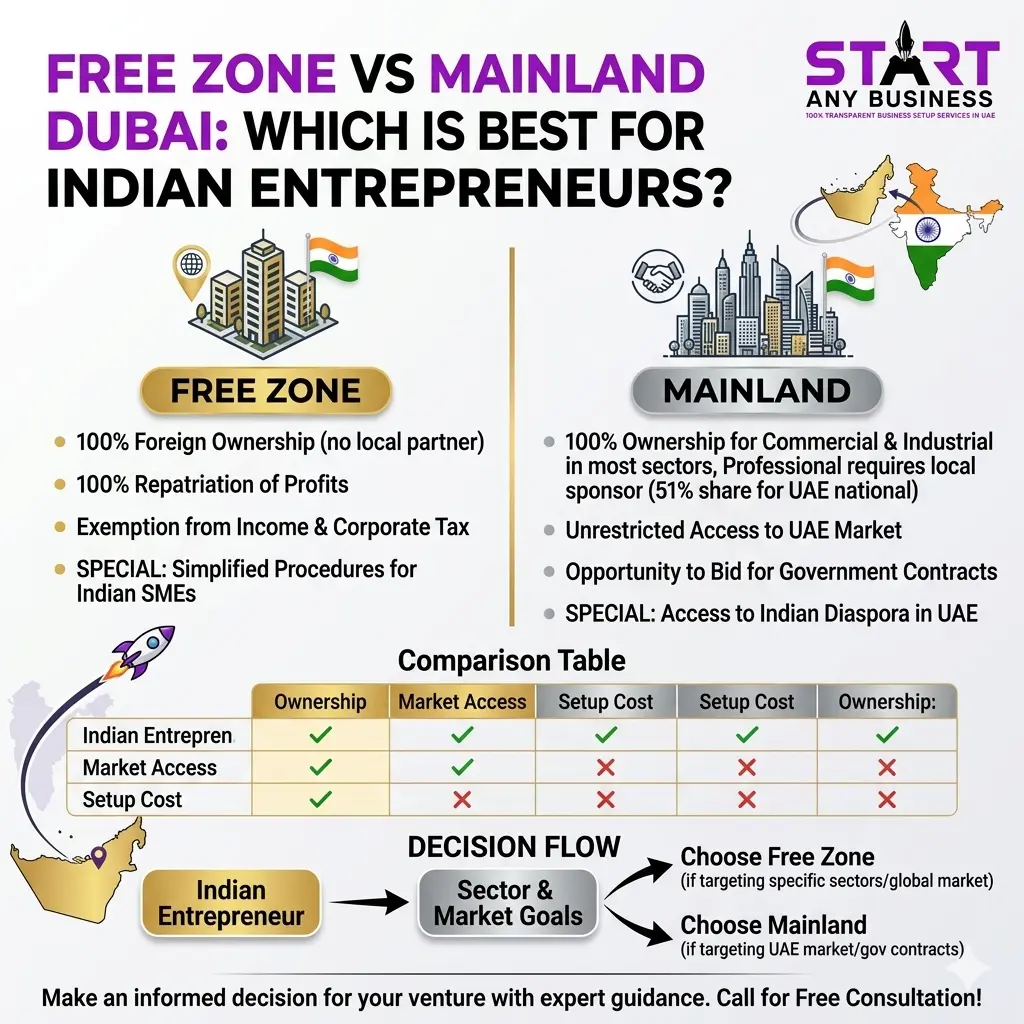
Key Differences: Freezone vs Mainland Company Setup
Understanding the Dubai free zone vs mainland business setup requires a detailed comparison across various parameters. Here is a complete overview of their key differences based on diverse factors:
| Basis | Free Zone Company | Mainland Company |
| Ownership Rules for Indians | Allows 100% foreign ownership with no need for a local sponsor in most cases. | Offers 100% ownership in many sectors, though some activities may still need local involvement. |
| Market Access | Requires a physical office space with Ejari registration, depending on business activity. | Can freely trade across the UAE market and internationally without restrictions. |
| Office Requirements | Offers flexible options like shared desks or virtual offices, reducing startup costs significantly. | The number of visas is generally linked to office size, allowing higher scalability. |
| Visa Benefits | Visa allocation depends on the size of the package or office space chosen. | A wide range of business activities allowed across multiple industries under one license. |
| Business Activities Allowed | Activities are limited to those permitted within the specific free zone authority. | A wide range of business activities is allowed across multiple industries under one license. |
| Government Contracts | Cannot directly participate in UAE government tenders or projects. | Eligible to apply for and execute government contracts and large-scale projects. |
| Setup Cost | Lower initial setup cost, which makes it best for startups and small businesses. | Higher setup cost due to office requirements and broader operational scope. |
| Renewal Cost | Annual renewal fees are usually predictable and relatively affordable. | Renewal costs can be higher due to office rent and compliance requirements. |
| Regulatory Authority | Governed by individual free zone authorities with simplified procedures. | Regulated by Dubai Economy and Tourism (DET) with a broader compliance framework. |
| Tax Benefits | Offers tax advantages, including exemptions depending on business type and compliance. | Subject to UAE corporate tax regulations, though still competitive globally. |
| Customs Duties | Generally exempt from import/export duties within the free zone. | Customs duties apply when importing goods into the mainland UAE. |
| Expansion Flexibility | Expansion outside the free zone requires additional approvals or separate licensing. | Provides complete freedom to expand operations anywhere within the UAE. |
| Banking Process | Easier account opening for startups, though it depends on business activity and profile. | May involve stricter due diligence but offers broader banking credibility. |
| Physical Presence | In some cases, no full-time physical office is required to operate. | A physical office is mandatory for most business activities and license approvals. |
| Hiring Flexibility | Hiring is limited based on visa quotas defined by the free zone authority. | Greater flexibility in hiring employees without strict quota limitations. |
| Audit Requirements | Some free zones do not require mandatory audits for small businesses. | Audit and financial reporting are often mandatory depending on the activity. |
| Business Scope | Best suited for niche, online, or international trade-focused businesses. | Suitable for almost all types of businesses, including retail, services, and contracting. |
| Trade Restrictions | Cannot directly sell goods/services in the mainland without a local agent. | Cannot directly sell goods/services in the mainland without a local agent. |
| Suitable For | Startups, freelancers, and export-oriented entrepreneurs with limited budgets. | Established businesses targeting UAE customers and long-term regional growth. |
The above comparison helps you understand the advantages and limitations that each jurisdiction offers. It also highlights Dubai business setup cost-free zone vs mainland and operational flexibility differences clearly to help you make a wise choice.
Also Read: Cost of Setting Up a Company in Dubai for Indian Entrepreneurs
Why Mainland is Better for Indians?
The decision between Free Zone vs Mainland Dubai for Indian entrepreneurs depends on their business needs and their plans to grow their operations. Here are some of the key features that define why Mainland is a better option for businesses from India in 2026:
- It gives direct access to the UAE customers without any limitations or intermediaries.
- One can bid for UAE government tenders and large infrastructure projects with mainland company formation in Dubai From India.
- It allows you to open offices anywhere across Dubai and the UAE.
- Indian business owners can operate retail stores, restaurants, and service-based businesses targeting locals.
- There are no visa limitations, which leads to rapid expansion and extensive hiring of the workforce.
Why Free Zone is Better for Indians?
In the Free Zone vs mainland benefits, Dubai, Indian entrepreneurs can consider free zones as their go-to choice because of the following specifications:
- Free zones in Dubai From India come with budget-friendly business setup solutions.
- Indian business owners can run an online, consulting, or export-focused business with global clients
- It offers quick registration and minimal paperwork for faster entry into the market.
- Offer tax benefits and simplified compliance requirements
- One can operate in specific sectors like media, tech, logistics, or finance
How to Decide the Right Option?
To choose between the mainland vs free zone for Indian entrepreneurs, entrepreneurs must evaluate their business goals carefully. They must evaluate several factors before they make a decision. Key factors to consider include:
- Target market location
- Budget and investment capacity
- Type of business activity
- Need for office space.
- Expansion and hiring plans
Quick Decision Table For Indian Entrepreneurs
| Criteria | Choose Free Zone | Choose Mainland |
| Budget Friendly | Yes | No |
| UAE Market Focus | No | Yes |
| Global Trade | Yes | Yes |
| Government Projects | No | Yes |
| Flexible Expansion | No | Yes |
| Quick Setup | Yes | No |
This comprehensive table helps you simplify your choice and make the right decision when it comes to the Dubai business license free zone vs mainland.
Common Misconceptions About Free Zone and Mainland Companies
Let’s take a closer look at some of the common misconceptions that entrepreneurs have. This will help you make a wise decision when you are looking to choose between the mainland vs free zone in Dubai From India:
- Freezone Companies Can’t Trade Locally: Many believe free zone companies cannot sell in the UAE, but they can trade locally by appointing a distributor or opening a mainland branch. This makes local market access possible for free zone enterprises.
- Mainland Companies Are Always More Expensive: It is often assumed mainland setup is costly, but costs vary by activity, office size, and approvals, and some businesses find mainland more cost-effective long-term due to flexibility.
- All Industries Are Allowed in Freezones: Not every business activity is permitted in free zones, as each zone has specific allowed sectors, so entrepreneurs must choose a zone aligned with their business activity requirements.
Conclusion
Choosing between the Free zone vs mainland Dubai depends on your business vision, target audience, and growth strategy. Free Zones are extremely suitable for startups and international operations, while Mainland companies offer unmatched local market access and expansion flexibility. By understanding your priorities and comparing both options carefully, Indian entrepreneurs can make a confident decision that ensures long-term success in Dubai’s From India dynamic business environment.
Starting a business in Dubai From India involves several steps to be followed that might be challenging for Indian entrepreneurs, especially when choosing between a Dubai free zone vs mainland business setup. Start Any Business UAE (India branch) makes this journey easy for you. Headquartered in the UAE with an operational branch in India, our business consultancy firm helps you with the right setup, paperwork, office acquisition, and more. We understand Indian entrepreneurs well and help them establish their business without any stress in the dynamic city of Dubai.
Also Read: Top 20 General Trading Products Business Ideas from India to Dubai